Search This Blog

Showing posts with label startup. Show all posts

Steve Blank, What's A Startup?

August 01, 2015 No comments :
This is a discussion of Steve Blank's impressively succinct essay What's A Startup?. It is part of a series of discussions of foundational texts on What is a startup business?

You can buy his book, The Startup Owner's Manual here:

Steve Blank


Blank is known primarily as a theoretician, although he has founded and advised many companies. His ideas have been very influential in the culture.

What's A Startup?


Blank has been thinking about startups for a while, so his blog post are focused, but peppered with reference to other areas where he expands on the topic.

He gets right to the point:
In this post we’re going to offer a new definition of why startups exist: a startup is an organization formed to search for a repeatable and scalable business model. (Blank)
And then he unpacks the idea of a business model.

A business model describes how your company makes money. (Blank)
So a startup is an organization formed to search for a repeatable and scalable way to make money. That sounds like any business. What sets Blank's theory apart is probably the detailed process he lays out to form such a business.

Q: Peter Thiel seems to disagree with Blank's model. In particular he advises startups to have big bold plans, that can be modified indefinitely, which deliver an enormous innovation that earns a monopoly. Blank doesn't think this contradicts his own view. Do readers think there is a fundamental distinction here?

The Business Model Canvas


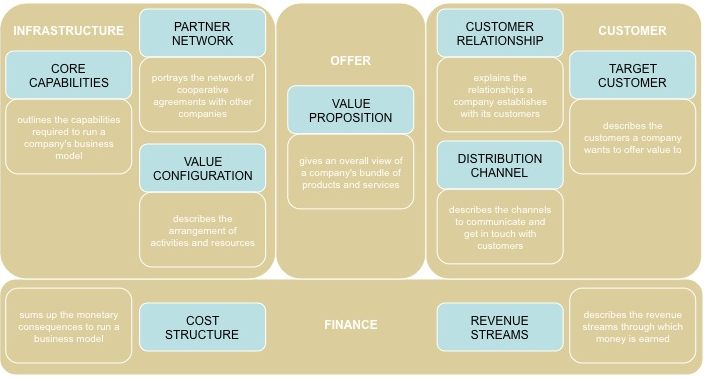
Blank is a fan of the Alexander Osterwalder's Business Model Canvas , which is a template to organize the components of a business.
https://steveblank.files.wordpress.com/2010/01/osterwalder-business-model.jpg

Startup as hypothesis testing


Blank has specific advice on the role of a founding team.
Your job as a founder is to quickly validate whether the model is correct by seeing if customers behave as your model predicts. Most of the time the darn customers don’t behave as you predicted. (Blank)
The benefit of this advice is it focuses energies on hypothesis testing early on.

Contrast: Although Thiel has claimed that this advice contradicts to come up with a long term plan, the tenure of the plan doesn't seem to be a central component of Blank's thesis. There is something about the MVP that feels small and timid, compared to Thiel's idea of going from 0 to 1 which feels ambitious and large in scale. The question is, if Blank had used a different word -- Initial Hypthesis Product, for instance -- would there still be a fundamental disagreement?

Q: Blank realizes of course that experimentation can be very expensive. You can't usually launch an entire business to see if customers like it, so his idea is to put out a really simple minimal viable product and use that to test it.

The big criticism -- and I am not the first to make it -- is this contrast directly with advice from other people.

Famously, Steve Jobs said in an interview:
"It's not about pop culture, and it's not about fooling people, and it's not about convincing people that they want something they don't. We figure out what we want. And I think we're pretty good at having the right discipline to think through whether a lot of other people are going to want it, too. That's what we get paid to do.
"So you can't go out and ask people, you know, what the next big [thing.] There's a great quote by Henry Ford, right? He said, 'If I'd have asked my customers what they wanted, they would have told me "A faster horse." ' "(Steve Jobs)
This is not the first time Jobs had said this.

Blank is well aware of this criticism, but I don't know that he fully takes on the problem.


You can buy his book, The Startup Owner's Manual here:


Eric Reis, What is a startup?

August 01, 2015 No comments :

This is a discussion of Eric Reis' esay What is a startup?. It is part of a series of discussions of foundational texts on What is a startup business?

You can purchase Eric's book by clicking on this link:


Eric Reis


Eric Reis has worked for several startups, and has worked with Steve Blank. He is most closely associated with "Lean Startup," which itself is associated with Steve Blank's work.


What is a startup?


Reis' gets to the point early:
A startup is a human institution designed to deliver a new product or service under conditions of extreme uncertainty. (Reis)
He goes on to take that sentence apart, and defends the use of key phrases, arguing that they are critical. The words that he explains are "human," "new" and "uncertainty."

Human institutions

Reis correctly points out that all institutions are human institutions, except in the narrow sense made up for the sake of argument. However, he goes on to say.
Even for companies that essentially have only one product, the value the company creates is located not in the product itself but with the people and their organization who built it. (Reis)
And the point he makes here is that the systems and habits that a company generates may be as valuable as a piece of technology. Paul Graham explicitly calls new ways of doing this a new technology in the "broad" sense:
The other connection between startups and technology is that startups create new ways of doing things, and new ways of doing things are, in the broader sense of the word, new technology. (Graham)
Although Thiel positions himself contra the lean startup, I don't think he would disagree with this component. One alternative view, however, may come form Marc Andreessen who specifically thinks that a market can pull a product form a mediocre team. Reis is closely aligned with Blank, who acknowledges the centrality of the product market fit in the lean model.


Newness


Reis
And yet the newness of a startup’s product or service is also a key part of the definition. This is a tricky part of the definition, too. I prefer to take the most expansive possible definition of product, one that encompasses any source of value for a set of people who voluntarily choose to become customers. (Reis)
In his emphasis on novelty, Reis sounds closest to Thiel who emphasizes novelty more than almost anyone else we look at. However, Reis has a different idea of novelty:
Even the most radical new inventions always build upon previous technology. Many startups don’t innovate at all in the product dimension, but use other kinds of innovation: repurposing an existing technology for a new use, devising a new business model that unlocks value that was previously hidden, or even simply bringing a product or service to a new location or set of customers previously underserved. (Reis)
Contrast: This may contrasts with Thiel's notion of a startup because I suspect other improvements would count as 1 to n improvements for Thiel. These improvements would not lend themselves to sufficient differentiation to earn a monopoly.

Uncertainty


Reis has the most expansive notion of a startup of any definition I have seen, and the result is that he may define a traditional business very narrowly.
Startups are designed to confront situations of extreme uncertainty. To open up a new business that is an exact clone of an existing business, all the way down to the business model, pricing, target customer, and specific product may, under many circumstances, be an attractive economic investment. But it is not a startup... (Reis)

However, his emphasis on the uncertainty again echoes Thiel's view of a startup taking on a novel problem:
Thus, the land of startups is a unique place, where the risks themselves are unknown. ... Startups are designed for the situations that cannot be modeled, are not clear-cut, and where the risk is not necessarily large – it’s just not yet known. (Reis)

Q: Although uncertainty is where Reis and Thiel agree, it is also where Graham and Andreessen seem to agree with them. Graham considers good ideas to occur in the space where change happens because other spaces are already picked over. Andreessen considers the question of product/market fit to be the big question that is being explored. Is this the area that all definitions converge? Is there anyone that doesn't consider uncertainty to be a hallmark of startups? Or is uncertainty simply the hallmark of all business?


You can purchase Eric's book by clicking on this link: